
The Office of Final Corrections
Toca una palabra para traducirla y guardarla para practicar.
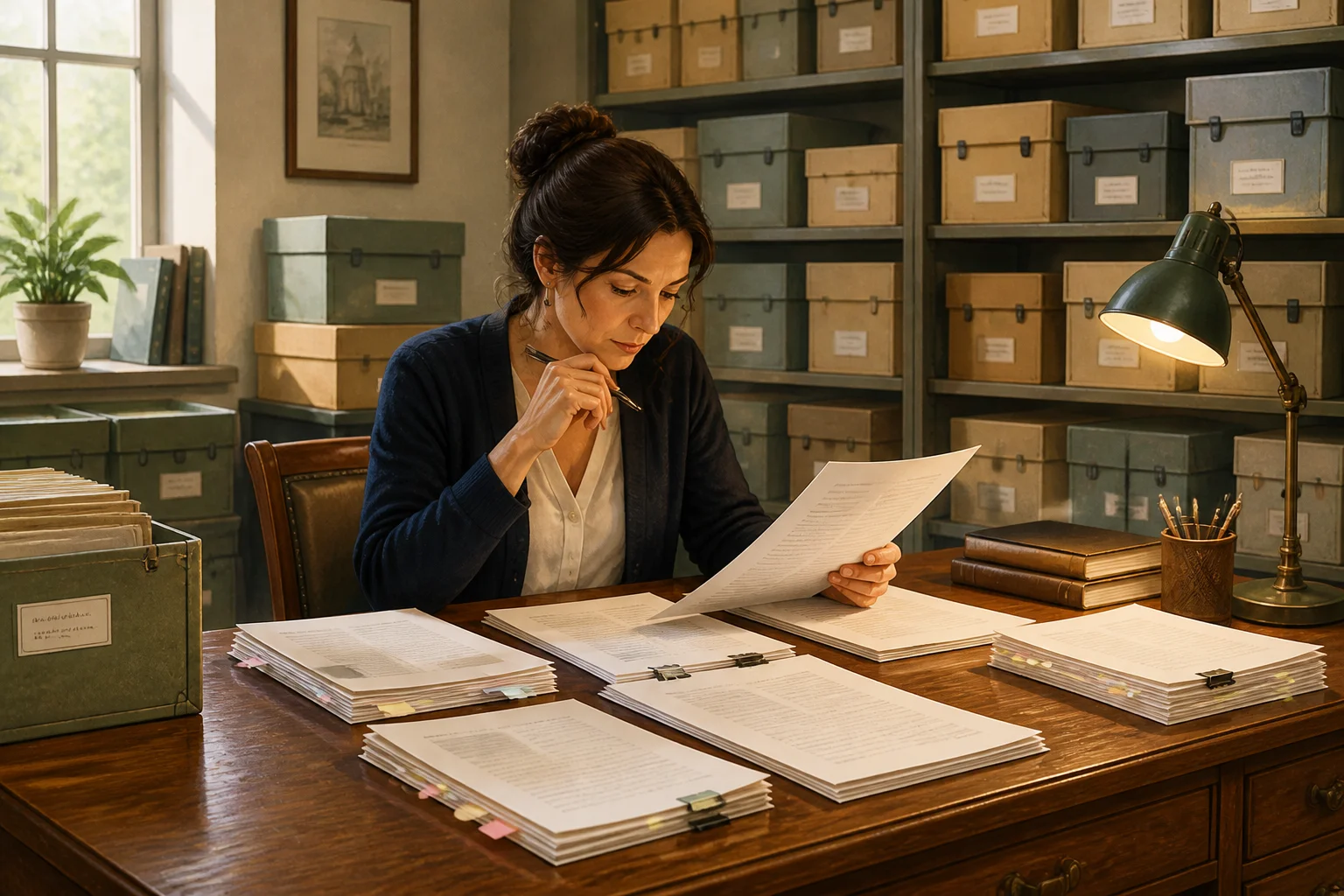
By the time the commission dissolved, its findings had been revised so often that the final report possessed the reassuring smoothness of something no individual could reasonably be accused of having written. My appointment was a modest one: resolve inconsistencies in the archive before its transfer to the public library.
I was not, the chair emphasised, to reopen conclusions. The distinction between correcting the record and changing it was to remain scrupulously intact, preferably without requiring a definition.
The difficulty concerned a single verb. An early draft stated that residents had been "excluded" from consultation; the approved version said they had been "unavailable". The attendance sheets demonstrated their absence. They did not demonstrate its cause. A box of undelivered invitations, discovered in a cupboard, complicated matters without, according to the chair, altering the evidential position.
I proposed that both drafts be retained with a note explaining the discrepancy. This was welcomed as an admirably balanced solution, until it became apparent that readers would then be able to compare them.
The chair suggested a formulation: "The wording was clarified during review." I asked what, precisely, had become clearer. He smiled as though I had made a joke insufficiently kind to repeat.
In the end I placed the invitations beside the attendance sheets and preserved the drafts in chronological order. My covering note described where each document had been found. It did not say what anyone intended.
At the farewell reception, the chair thanked me for my discretion. I thanked him for allowing me to complete the work independently. We were both able to say these things sincerely, provided neither of us enquired too closely into the other's meaning.
The archive opened the following spring. I have not returned to see how it is catalogued. I tell myself this is because the work belongs to the public now; it is possible that I also prefer not to discover how successfully I have been understood.
Las palabras de los párrafos que lees se añaden a Vistas una vez por texto y día UTC. Es una estimación de exposición, no de comprensión.
Comprueba tu comprensión
Ficción original creada con ayuda de IA. Los niveles del MCER son orientativos.