
Interactive English Reading Practice: Read, Translate and Review New Words
A short story can give you something interesting to read and a few useful words to practise afterwards. With interactive English reading practice in FluentPop, you can select a word for translation, save it with its context, and return to it in a flashcard review. You can also generate example sentences and a short dialogue to see the word in a new situation.
Start with the passage below. Read it once for the main idea, then try the question before revealing the answer.
Try a short reading passage
This is an excerpt from The Night Bakery, a story labelled A2 in the reading library. The level is a guide: choose a text whose main events you can follow with a little help.
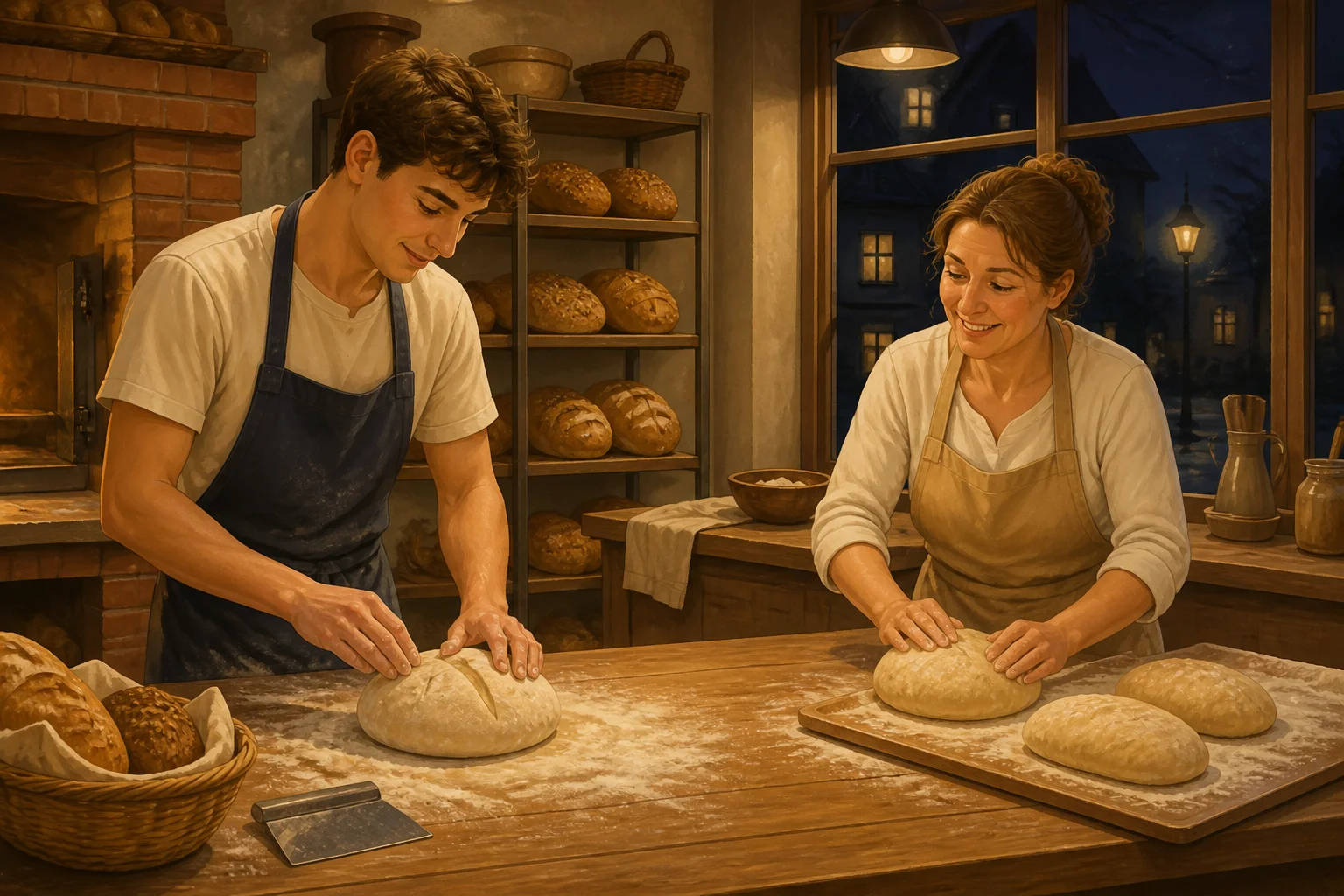
Rob started a new job in a bakery. His first shift began at eleven at night. "Who buys bread at this time?" he asked the owner.
"We make it now so it's ready in the morning," she explained.
Rob put small pieces of dough, the mixture used to make bread, on long trays. The work was harder than he expected. At two o'clock, his arms hurt, and he wanted to sit down.
Then a customer came to the side door to buy breakfast. She was on her way to work. The owner gave her a warm roll.
Check your understanding
Why does the owner say they make bread at night?
- A. To have it ready for the morning.
- B. To finish before Rob starts work.
- C. To prepare it after the customer returns from work.
Show the answer and explanation
A — To have it ready for the morning. The owner says, "We make it now so it's ready in the morning." Rob is already working, and the customer is on her way to work.
The complete story follows the other customers who arrive before sunrise. Its reading page includes word translations and three interactive comprehension questions.
Translate an unfamiliar word in its context
Look again at this sentence:
His first shift began at eleven at night.
You know that Rob has a job and starts at a particular time. That gives you a clue about the meaning of shift.
Reveal the meaning of “shift” in this story
A shift is a scheduled period of work. Rob's shift starts at eleven at night.
For example, a Spanish translation for this meaning is turno de trabajo. The phrase night shift means a period of work during the night.
To use the translation tool yourself, open the interactive story and click or tap shift. Choose the language you want translations in if prompted. The word-help panel shows the translation and provides a pronunciation button.
The explanation above is a worked example for this guide. The translation tool uses your selected language. Check that the meaning fits the sentence: shift can also mean a change or movement in other contexts.
You do not need to stop at every unfamiliar word. Check words that block your understanding or that you would like to use yourself, then continue reading.
Save the word for practice
With the translation open, choose Save to practise. You can then find the word in Saved Words, together with its translation and the context from the passage.
For shift, the useful connection is more than a single translated word:
- Meaning: a period of work.
- Context: Rob starts his bakery shift at eleven at night.
- Useful phrase: night shift.
Start with a small selection. From this passage, you might save shift and tray. Saving every word is unnecessary if you already know it or do not want to practise it.
Generate an example sentence and a dialogue
The original passage shows shift in a bakery. A new example can show you how to use it when talking about a different job or your own schedule.
In Saved Words, open Study words. When the review card for your word appears, choose Get Examples & Dialog in the Word pack section. This generates example sentences and a short dialogue for the word.
Generate an example sentence
Here is an example written for this guide:
My shift ends at six, so I can meet you for dinner at seven.
Notice how shift works with ends. In the story, it worked with began. Try changing the time or the plan to make a sentence of your own:
My shift ends at ___, so I can ___ afterwards.
If you do not work shifts, you can describe someone you know or invent a character.
Generate an example dialogue
A dialogue puts the word into an exchange between two people. For example:
Maya: Can you have lunch with us tomorrow?
Rob: I can, but my shift starts at two.
Maya: Let's meet at twelve, then.
Read both parts aloud, then cover Rob's answer and make your own reply using shift. You could change the starting time or suggest a different meeting time.
These examples illustrate the feature; the AI-generated results will vary. Check that an example makes sense in the context you want. Generation is subject to the allowance shown in the app.
Review with flashcards when words are due
Return to Saved Words → Study words for your scheduled reviews. Try to recall the meaning before choosing Show Translation. If you need the original context, use Show Sentence.
After checking, select the rating that describes your recall:
- Again: you could not remember the word.
- Hard: remembering it was difficult.
- Medium: you remembered it with some effort.
- Easy: you recalled it easily.
The card shows the next review timing beside the ratings. Use the timing displayed for that word, because it depends on its review history. A word rated Again is due today; you can reopen Study words to practise it again.
This is how spaced repetition fits into your reading: you meet a word in a story, try to recall it later, and return to it across separate sessions. Rate your recall honestly so the schedule reflects how the word feels to you.
Finish the story, then use one new word
After checking shift, continue reading The Night Bakery and answer its three questions. If an answer is wrong, use the explanation to find the relevant part of the text.
Finish with one sentence of your own. It could describe a work schedule, a visit to a bakery, or something you plan to do tomorrow. That gives you a concrete use for the vocabulary you have just saved.
For another session, choose from 10 A2 stories with questions, or browse factual articles in the reading library. If you want a longer text built around several saved words, see how to create AI stories with your own vocabulary.
Start learning on LearnMovies