
B1 English Reading Practice: Short Texts with Questions and Answers
How do bees share directions? Why can a street stay warm after sunset? What builds a coral reef? These short English texts for intermediate learners give you something to discover while you practise reading.
Start with the B1 reading passage below, then answer its three comprehension questions before opening the explanations. You can also open the interactive version to translate unfamiliar words and save vocabulary for review. The articles and their quizzes are free to use without an account.
B1 reading passage: The Bees' Dancing Map
Reading focus: separate direction from distance, then notice what a study can and cannot tell us.
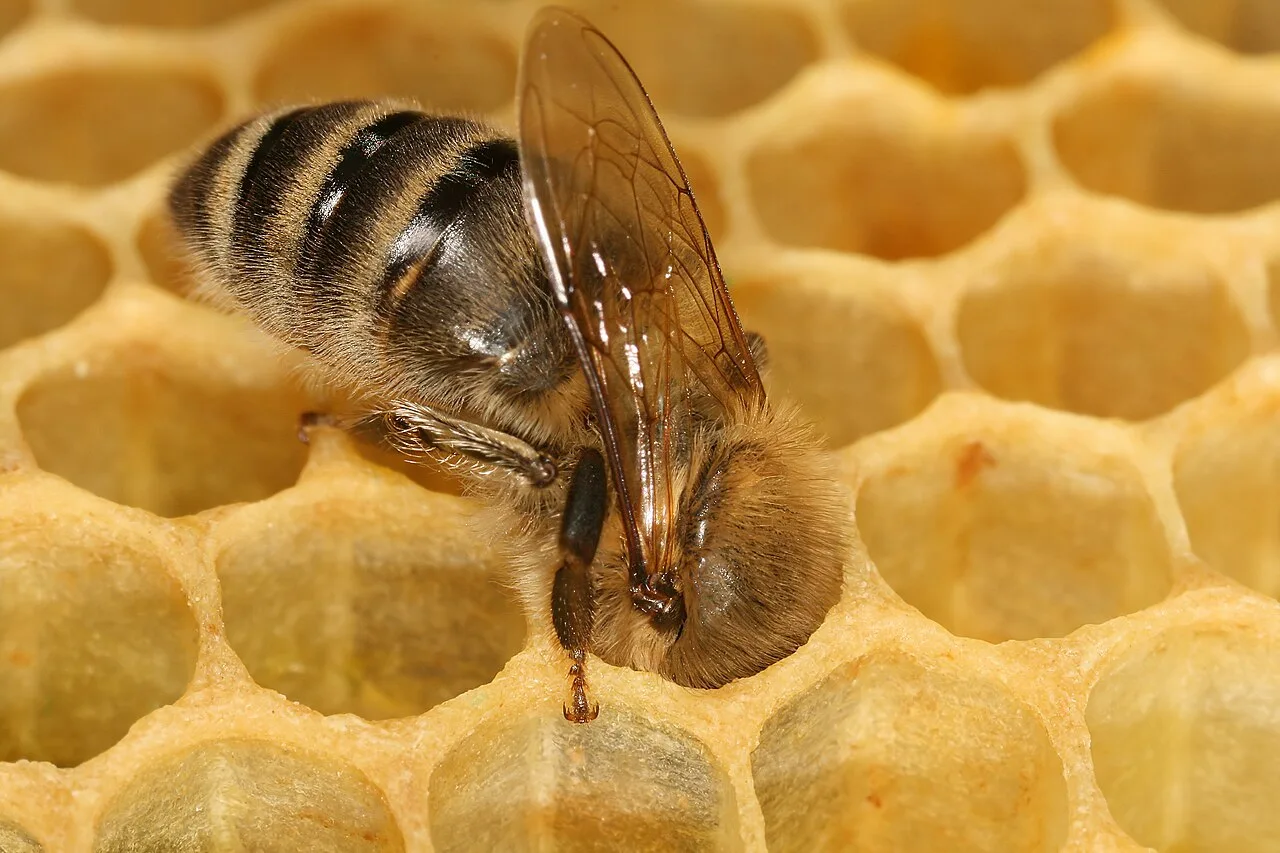
Photo: Richard Bartz and Hubert Seibring, CC BY-SA 2.5. Resized and converted to WebP.

How can a bee give directions without speaking? After finding food, a honeybee returns to its hive and can perform a waggle dance. Its movements tell other bees where to go.
Inside the hive, the bee moves forward while shaking its body from side to side. This straight part of the dance is called the waggle run. The bee then circles back and repeats the movement, returning on the other side.
The angle of the waggle run shows the direction of the food compared with the position of the Sun. On the vertical honeycomb, a run straight upwards means the food is towards the Sun. The longer each waggle run lasts, the farther away the food is.
Researchers at the University of Sussex study these dances using video recordings. By measuring the angle and timing each waggle run, they can work out where the bees have found food. The dances help them understand the landscape around the hive.
In one study, bees travelled farther in summer than in spring or autumn. This suggested that suitable food was harder to find in summer in the area studied. However, bees in other places may face different conditions. The same seasonal pattern does not necessarily apply everywhere.
Reading passage from our interactive bee article. Research background: University of Sussex — decoding waggle dances and the original study of seasonal foraging distances.
Check your understanding
Choose one answer for each question. You can look back at the passage: the aim is to understand the text, not to memorise every sentence.
1. What tells other bees how far away the food is?
- A. Which direction the bee moves.
- B. How long each waggle run lasts.
- C. How many times the bee circles back.
2. Why do the researchers measure both the angle and the time of a waggle run?
- A. To work out the direction and distance of the food.
- B. To estimate the number and size of the flower patches.
- C. To calculate the speed and length of the return flight.
3. What can we conclude from the longer summer journeys in the study?
- A. Food was farther away because it was better in summer.
- B. Bees in other places must travel farther in summer too.
- C. Suitable food seemed harder to find locally in summer.
Show answers and explanations
- B — How long each waggle run lasts. The third paragraph links a longer waggle run with food that is farther away. The angle gives information about direction.
- A — To work out the direction and distance of the food. These two measurements help the researchers locate the food. The passage does not say that they use the dance to measure flight speed or the size of a flower patch.
- C — Suitable food seemed harder to find locally in summer. Notice the words “in the area studied.” The final paragraph does not say that the same pattern happens everywhere or that summer food is better.
For the third question, compare “This suggested” with “This proved.” The passage presents an interpretation of a finding, then explains its limits. Noticing these small differences helps you choose an answer that the text supports.
Five useful words and phrases
| Word or phrase | Meaning in this passage | Another example |
|---|---|---|
| hive | A home where a group of honeybees lives. | The bees returned to the hive before the rain. |
| angle | The amount of turn between two lines or directions. | Hold the camera at a different angle. |
| work out | Find an answer by thinking or using information. | We used a map to work out the quickest route. |
| landscape | The land and features of an area, such as fields and hills. | The landscape changed as we left the city. |
| suitable | Right for a particular purpose or situation. | These shoes are suitable for a long walk. |
In the interactive article, tap or click an unfamiliar word to see its translation in your selected language. Choose Save to practise for a word you want to remember, then open Saved Words to review it.
Try using suitable in a sentence about your own life: “This ___ is suitable for ___.” You can also generate an example sentence or a short dialogue from a saved word when you want another context. Our interactive reading guide shows how these tools work.
Two more B1 reading texts to try
Each article below has three comprehension questions with answers and explanations on its reading page.
Why Cities Stay Hot After Sunset
Leaving a cool park for a warm street can feel like entering a different climate. This article explains how roads and buildings store and release heat, and how trees affect their surroundings. It also asks you to distinguish the temperature of a surface from the temperature of the air.
Practise: following causes and effects, and comparing information carefully.
Vocabulary to notice: surfaces, release, surroundings.
Read Why Cities Stay Hot After Sunset and answer its questions.
The factual background comes from the US Environmental Protection Agency's explanation of heat islands.
The Tiny Animals That Build Reefs
A coral reef may look like a garden or a collection of rocks, but its living builders are animals. Read about coral polyps and the algae that share their home. Then check the difference between coral bleaching and coral death.
Practise: understanding a partnership and recognising a distinction that changes the meaning of a statement.
Vocabulary to notice: colonies, skeletons, survive.
Read The Tiny Animals That Build Reefs and answer its questions.
For the science behind the passage, see NOAA's introduction to corals.
A short routine for reading practice
- Read once for the main idea. Try to describe the topic in one sentence before checking individual words.
- Answer the questions. For each answer, find the part of the passage that supports it.
- Check a few useful words. Translate words that block your understanding or that you would like to use yourself.
- Recall something from the text. Close it and explain one thing you learned in your own words.
- Review your saved vocabulary later. Try to recall a word's meaning before revealing it on the flashcard.
Choose one article for a session. You can return for another when you want a new topic.
Is this the right reading level for you?
These texts are labelled B1, or intermediate, in the reading library. The labels are estimates, not test results. The passages include some topic-specific words, so you do not need to recognise every word before you begin.
Try the bee passage first. If you can follow the main explanation and find evidence for your answers with occasional word help, it gives you a useful starting point. If almost every sentence feels difficult, try our A2 short stories with questions and answers.
Prefer fiction? Explore the B1 short stories. For more factual topics, browse the article library.
Start learning on LearnMovies